

Due to In modern industrial production, the stability and reliability of production equipment directly affect product quality, production efficiency and operating costs. Establishing a scientific and systematic equipment production inspection process is a key link to ensure that equipment performance meets standards and prevent faults from occurring. This article will provide a detailed introduction to the full-cycle inspection process of factory production equipment from procurement to daily operation, offering enterprises an operational implementation plan.
1.The preliminary inspection process for hypochlorous acid generator equipment
1.1 Technical assessment before procurement
Demand analysis: Clarify the production process requirements and determine the technical parameters of the equipment
Supplier audit: Evaluate the supplier’s qualifications, historical performance and after-sales service capabilities
Technical agreement confirmation: Specifies in detail the performance indicators of the equipment, acceptance criteria and inspection methods
1.2 Inspection after the equipment is produced
Visual inspection: Check the integrity of the outer packaging of the equipment and the condition of rust prevention treatment
Quantity count: Verify the consistency between the equipment list and the actual items
Document acceptance: Receive technical documents such as operation manuals, electrical drawings, and certificates of conformity
Initial inspection of key components: Conduct a preliminary quality assessment of vulnerable parts and precision components

2,Inspection during the installation and commissioning stage of the hypochlorous acid generator
2.1 Supervision of the installation process
Basic acceptance: Check the dimensions, levelness and position of embedded parts of the equipment foundation
Installation parameter detection: Professional testing instruments are used to test important parameters such as concentration, PH, and ORP.
Safety device verification: Confirm that safety facilities such as emergency stop buttons and protective covers meet the requirements
2.2 No-load trial operation detection of the equipment
Mechanical system inspection: Observe the smoothness of operation of each moving part
Electrical system testing: Check the stability of voltage and current, and verify the logic of the PLC program
Noise and vibration detection: Basic data is collected using decibel meters and vibration analyzers
2.3 Equipment load trial operation detection
Performance test: Verify the production capacity and processing accuracy of the equipment under rated load
Stability monitoring: Continuously operate for 8 to 24 hours to observe changes in important parameters such as temperature and pressure
First product inspection: Conduct full-scale inspection and performance testing of the trial production equipment
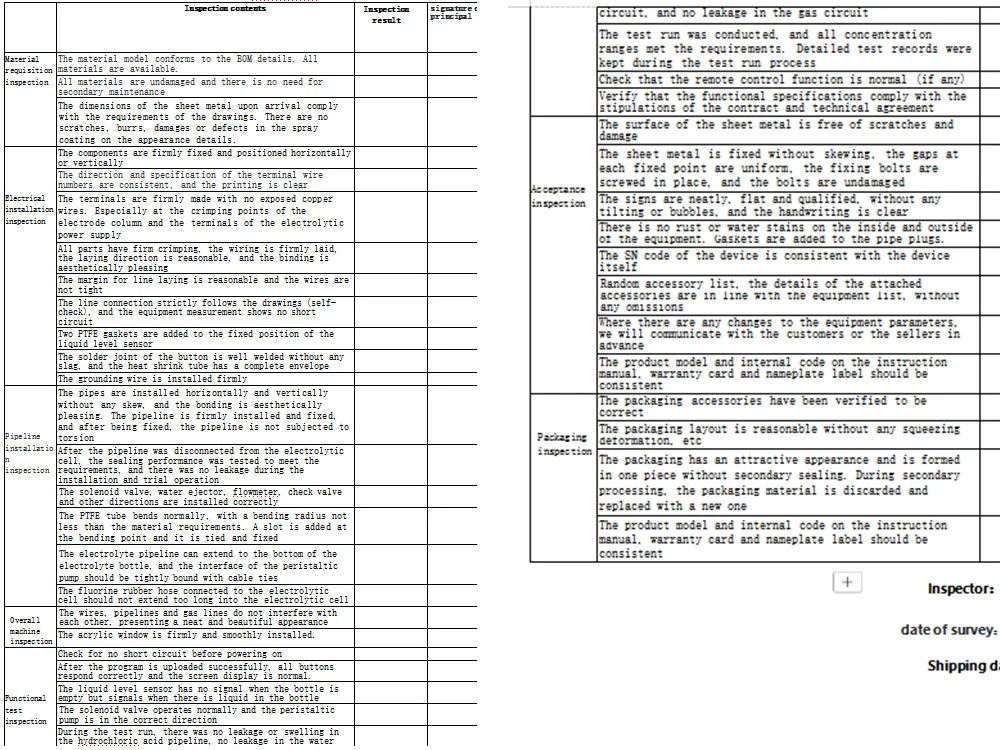
A scientific and rigorous inspection process for production equipment is an important pillar of the quality assurance system in manufacturing enterprises. By establishing a full life cycle and multi-level inspection system, enterprises can effectively prevent equipment failures, extend the service life of equipment, and ensure production stability and product consistency. With the development of Industry 4.0 technology, equipment inspection will become more intelligent and data-driven in the future. However, the fundamental concept of “prevention first” will always be the core principle of equipment management.