

In the meat processing industry. Frozen meat occupies an important market position due to its characteristics of easy storage. Transportation and cross-season sale. However, from slaughter segmentation to frozen storage. And then to later thawing processing. Microbial control and meat quality are always a pair of contradictions that are difficult to reconcile.
Traditional disinfection methods (such as chlorinated disinfectants, ozone or hot water) often have pain points such as incomplete sterilization, excessive residue, damage to meat quality or inconvenient operation. In recent years, the introduction of hypochlorous acid generator technology is completely changing this situation. It provides a “safer, more efficient and more economical” solution for the whole escort of frozen meat by preparing high-purity and high-activity hypochlorous acid disinfectant on site.

Challenges in frozen meat processing
Before diving into the advantages of hypochlorous acid generator. We first clarify the difficulties often encountered in the production of frozen meat enterprises:
- It is difficult to control the initial colony in the process of slaughter and segmentation: the surface temperature of the freshly slaughtered carcass is high. Which is easy to breed thermophilic bacteria. If the total number of initial colonies is too high. Some psychrophilic bacteria (such as Listeria and Pseudomonas) can still reproduce slowly at low temperature even after entering the freezing process, resulting in “green change” or odor of frozen meat in the later storage period.
2.Cross-contamination during freezing and thawing: Thawing is a high-risk period for microbial “resurrection”. The traditional way of water thawing is easy to lead to the loss of juice. And with the extension of thawing time. The microorganisms in the thawing water will increase exponentially. Resulting in cross contamination of the whole batch of meat.
3.Contradiction between chemical residue and sensory quality: Although traditional chlorine preparations (such as sodium hypochlorite) have good bactericidal effect. They have strong irritant odor. Easy to remain chlorine odor. And have strong corrosion to the operator’s skin and equipment. If rinsing is not clean, it will affect the color and flavor of the meat.
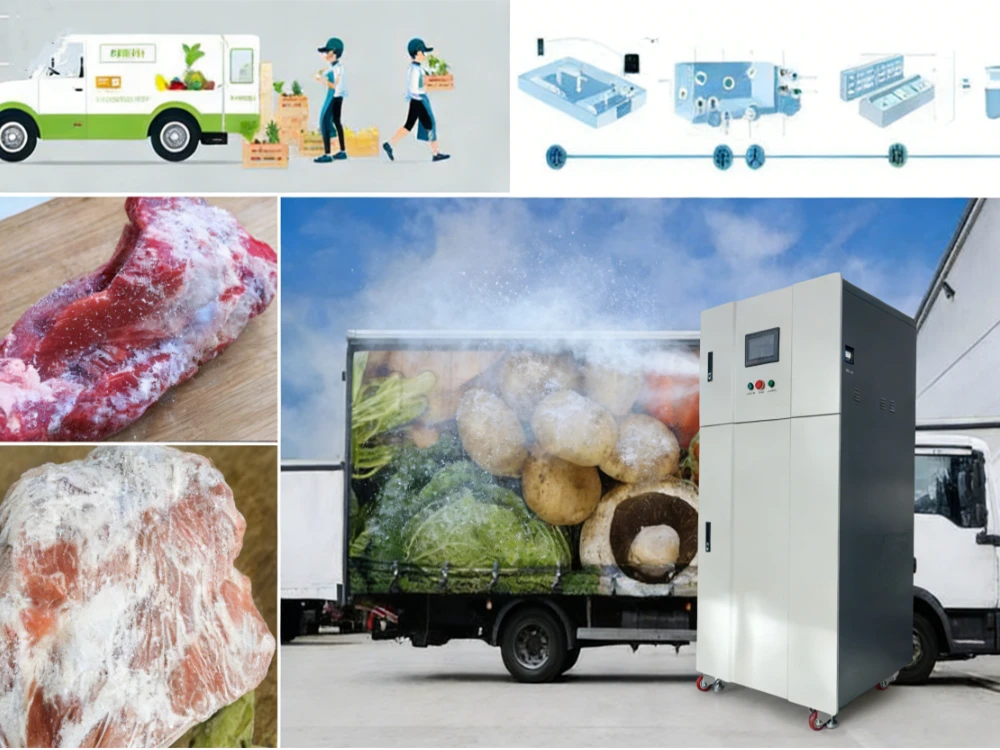
Technical principle of hypochlorous acid generator
A hypochlorous acid generator is a device that instantly produces slightly acidic/neutral hypochlorous acid (HClO) on-site by electrolyzing dilute hydrochloric acid or salt solution.
The hypochlorous acid generated by this technology is identical to the bactericidal substance released by human neutrophils. Its key advantage lies in its ability to achieve several times the bactericidal efficiency of traditional sodium hypochlorite at concentrations of 100-200 ppm. Even at low concentrations (10-30 ppm). This is because hypochlorous acid molecules are electrically neutral, allowing them to easily penetrate the cell walls of microorganisms and rapidly oxidize the cell nucleus, thereby killing bacteria, viruses, and fungi in a very short time (usually <30 seconds).


Four Core Advantages of Hypochlorous Acid Generators
1. Ultimate sterilization, reducing initial bacterial colonies from the source.
In slaughter lines and cutting workshops. Spraying or rinsing carcasses with hypochlorous acid water generated by a generator can reduce the initial total bacterial count on the carcass surface by 2-3 logarithmic orders (i.e., over 99.9%) without affecting the meat’s color.
- Highly targeted: It is particularly effective against Listeria monocytogenes, Salmonella, and Pseudomonas, which are common bacteria found in frozen meat.
- Low-temperature adaptability: Even at low temperatures of 0-4℃, hypochlorous acid maintains extremely high oxidizing activity. Solving the problem of decreased activity of traditional disinfectants at low temperatures.
2. Safe and residue-free, ensuring the quality of frozen products.
This is the most significant advantage of hypochlorous acid generators compared to traditional chemical disinfectants.
- No Harmful Byproducts: After reacting with organic matter. Hypochlorous acid is reduced to water (H₂O) and trace amounts of salt. Producing no carcinogenic byproducts (such as trihalomethanes).
- Color and Moisture Retention: During frozen meat processing. Hypochlorous acid water does not damage the meat protein structure. Effectively preventing the meat from darkening or turning black due to oxidation. Especially in the thawing process. Using hypochlorous acid water instead of ordinary water not only inhibits microbial outbreaks but also reduces juice loss. Maintaining the meat’s tender texture.
3. Produced and used immediately, with controllable costs.
Traditional disinfectants involve multiple stages such as procurement. Transportation, storage, and dilution. Posing safety risks and resulting in high long-term logistics costs.
- On-demand production: Hypochlorous acid generators require only electricity. Salt (or dilute hydrochloric acid), and water to produce disinfectant solutions of the desired concentration on demand. Eliminating storage risks.
- Low overall cost: Preparing 1 liter of hypochlorous acid water with an effective chlorine concentration of 10-30 ppm costs only a few cents. Compared to purchasing pre-made disinfectant solutions. Long-term operating costs can be reduced by 30%-50%.
4. Environmentally friendly and safe to operate.
- Mild pH: The slightly acidic hypochlorous acid has a pH value between 5.0 and 6.5, exhibiting extremely low corrosivity to metal equipment and causing no irritation to the skin or hands of operators. It can be used without the need for masks or heavy protective clothing.
- Environmentally Friendly: Wastewater from its use can be directly discharged without neutralization, aligning with the sustainable development principles of the modern food industry.
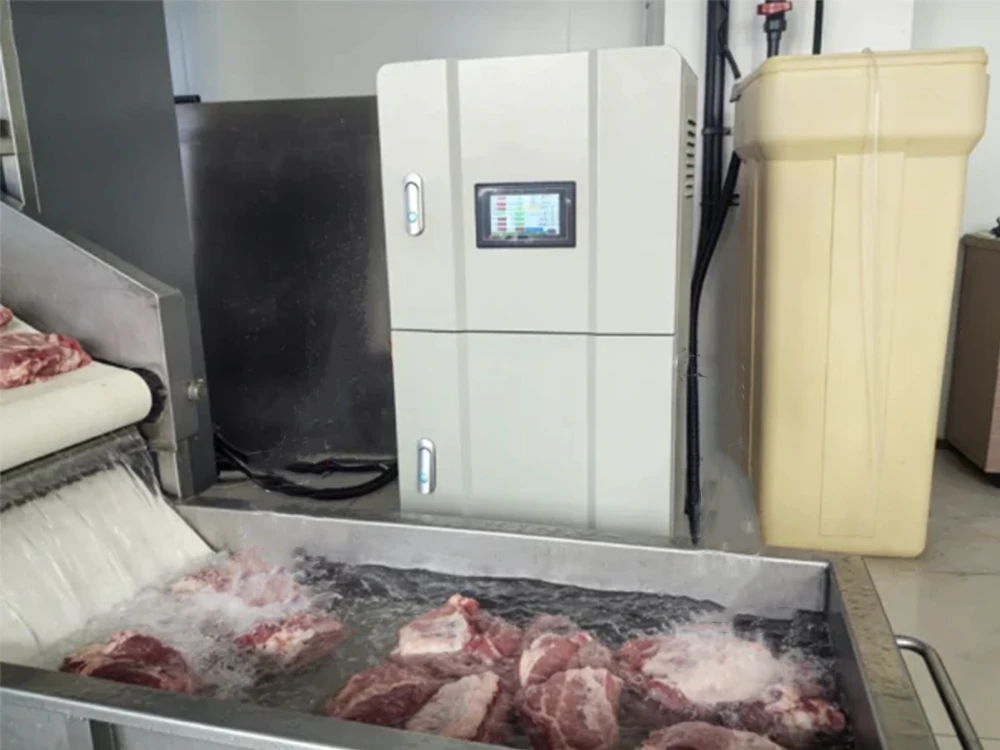
Hypochlorous acid generators are more than just disinfectant production equipment; they are comprehensive meat safety management systems. They resolve the contradictions of traditional disinfection methods—being highly efficient but unsafe, or safe but inefficient—achieving a perfect balance of high-efficiency sterilization, safety and non-toxicity, low cost, and guaranteed quality.
For frozen meat processing companies, introducing hypochlorous acid generators is not only a technological upgrade in the production process but also a crucial step in enhancing product competitiveness and building brand trust. In the future, with the popularization of green disinfection technologies, hypochlorous acid generators will inevitably become standard equipment in the meat processing industry.
FAQ
Can hypochlorous acid really be used for food preservation?
Yes, hypochlorous acid (especially slightly acidic hypochlorous acid solution) has been widely use in food preservation. Its principle is to use its strong oxidizing properties to kill pathogenic microorganisms (such as bacteria and fungi) on the surface of fruits and vegetables, thus slowing down the spoilage process. At the same time, hypochlorous acid can decompose ethylene (a ripening hormone naturally released by fruits and vegetables), further inhibiting the ripening rate.