Many buyers across agriculture, livestock and food processing share one big concern when they evaluate hypochlorous acid generators. They worry about unstable HOCl output and fast ppm drop after production. Recently, our technical team received a professional inquiry from a Chilean client. This client wants clear, quantified decay data and reliable storage solutions for on-site generated HOCl.
Why HOCl Naturally Faces Stability Challenges
First of all, hypochlorous acid breaks down easily by nature. Heat, UV light and improper pH values will speed up this decomposition. For farm owners and food processors, unstable HOCl brings real troubles. Weak disinfection effect, inconsistent sanitation results and also failed compliance checks are common risks. As a result, many project investors hesitate before placing orders.
How Our Hypochlorous Acid Generator Delivers Stable HOCl Output
To solve this pain point, we keep optimizing our electrolysis technology for years. Besides, we build four core controls into every hypochlorous acid generator. These controls lock stable pH and ppm levels for end users.
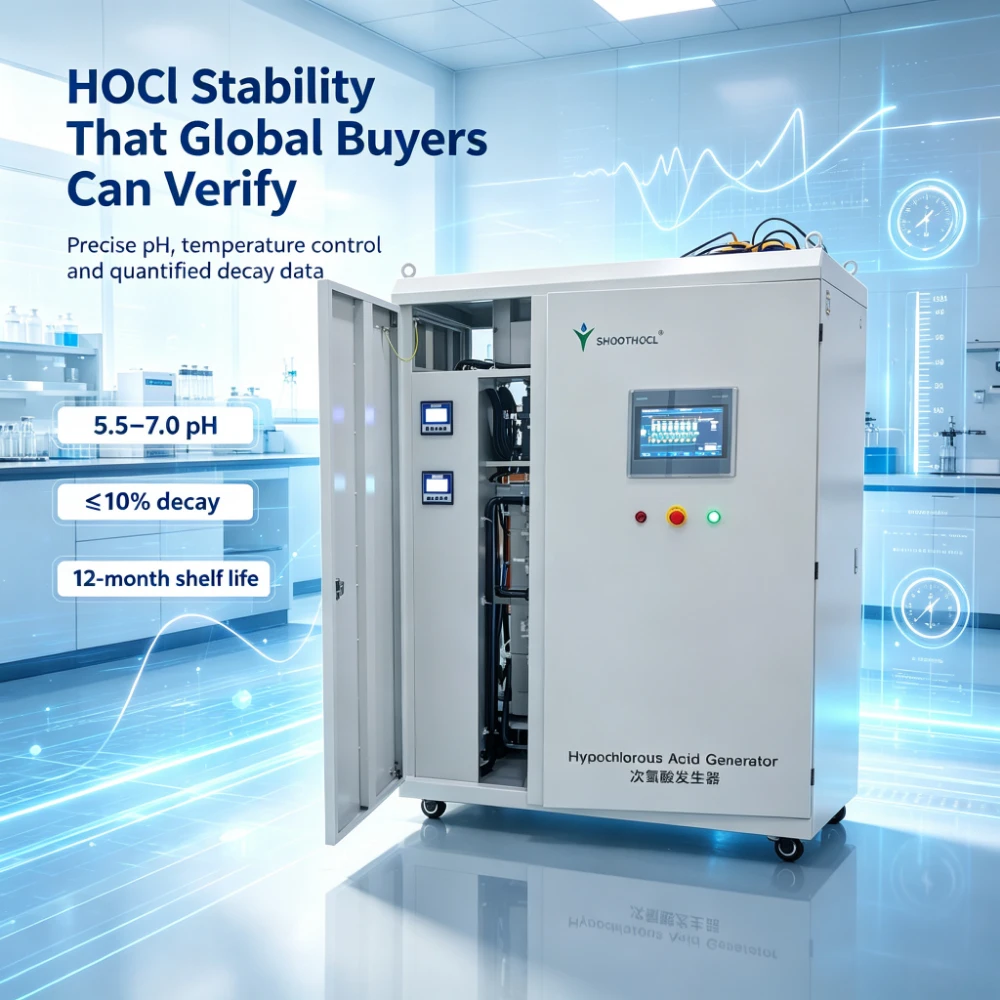
1. The system supports real-time and precise pH adjustment. It keeps output HOCl in the ideal 5.5–7.0 range. This range balances strong germ-killing power and storage stability, and we also support custom settings for different projects.
2. Constant temperature control runs during the whole electrolysis process. This is our key technical advantage. It keeps steady working conditions inside the electrolytic cell. In turn, it stops high heat from breaking down HOCl while it is being produced.
3.Standard storage rules support long shelf life without extra stabilizers. The HOCl liquid must stay sealed, away from sunlight and also high temperature. Under these rules, HOCl at ≤200 ppm keeps stable for up to 12 months.
4. All stability data comes from formal lab tests. On one hand, the 14-day accelerated aging test at 54°C shows decay below 10%. On the other hand, our 14-month long-term shelf test also controls decay within 10% under standard storage environments. All test records can be shared with clients.
For buyers who need bottled HOCl for export sales, we have extra options. We have mature stabilizer formulas to reach a 24-month shelf life. Our technical team can hold deep discussions with your engineers after cooperation starts at the same time.
What This Means For Your Projects
Whether you run greenhouse planting, livestock biosecurity or food sanitation lines, stable HOCl matters a lot. A reliable hypochlorous acid generator helps you get consistent disinfection results every day. It also helps you pass local inspection standards smoothly.
If you are sourcing
HOCl equipment and focus on stability, test reports and also export compliance,
reach out to our team now. We can share full test data and tailor solutions for your application.
FAQ
Q1: How long can the HOCl from your generator stay stable without stabilizers?
A1: With proper sealed, light-proof and also cool storage, HOCl ≤200 ppm stays stable for 12 months. Its decay rate stays under 10% based on our lab tests.
Q2: What causes HOCl to lose its concentration quickly?
A2: High temperature, direct sunlight and open containers are the main triggers. Also, pH outside the 5.5–7.0 range will speed up decomposition.
Q3: Can you support 24-month shelf life for bottled export HOCl?
A3: Yes. We have ready stabilizer formulas for this demand. We can connect with your technical team once we confirm cooperation.