

Onions, as an important vegetable widely cultivated and consumed around the world. Have long been a problem for farmers and distributors due to their spoilage and deterioration during storage. Traditional cleaning and preservation methods may carry risks such as poor effectiveness or chemical residues. In recent years. A green and highly efficient disinfectant called “hypochlorous acid” has gradually emerged as a new star in the field of post-harvest preservation. Providing a brand-new solution for the cleaning and preservation of Onions.
Why choose hypochlorous acid to treat Onions
During the harvesting, transportation and processing of Onions, their surfaces will be contaminated with soil. Dust and a large number of microorganisms (including bacteria, molds, yeasts, etc.). These microorganisms are the main cause of diseases such as rot, mold and soft rot in Onions during storage. Hypochlorous acid, due to its unique advantages, is highly suitable for post-harvest treatment of Onions
1,Highly efficient and broad-spectrum bactericidal ability: Hypochlorous acid can rapidly penetrate the cell walls of microorganisms. Destroy their enzyme systems and DNA structures. And has a very strong killing effect on Escherichia coli, Salmonella, Listeria. And various molds that cause rot (such as botrytis cinerea). Effectively reducing the rot rate of Onions in the later stage.
2,Extremely high safety: Hypochlorous acid is safe and harmless to the human body. After its action, it decomposes into water and trace amounts of sodium chloride, leaving no harmful residues. This avoids the possible chemical residue problems caused by traditional preservatives and meets modern consumers’ requirements for food safety.
3,It will not affect quality: Cleaning with an appropriate concentration of hypochlorous acid solution will not change the color. Flavor and texture of Onions. Instead, it can effectively remove surface dirt, making the appearance cleaner and more lustrous.
4,Environmentally friendly and pollution-free: The decomposition products are harmless and friendly to the environment, making it a green disinfection option.

The Application of Hypochlorous Acid in the Cleaning and Preservation of Onions
The application process of hypochlorous acid for cleaning and disinfecting Onions
1,Prepare the working solution: Use food-grade hypochlorous acid disinfectant and dilute it to a solution with an effective chlorine concentration of 50-80 mg/L. If the concentration is too low, the effect will not be good; if it is too high. It may cause slight bleaching to the onion skin (although it does not affect edibility. It affects the appearance and commercial quality).
2,Washing and soaking: After the Onions have been initially select and the surface dry skin and soil remove, they should be immerse in a hypochlorous acid solution for 3 to 5 minutes. During this period, gently turn it over to ensure that every part can fully come into contact with the solution.
3,Rinsing and air-drying: After soaking, remove the onion and rinse it briefly with clean water (this step can also be omit as hypochlorous acid itself leaves no residue). Then place it in a well-ventilated, cool and dry environment to thoroughly dry the surface moisture. Remember, it must be completely air-dried before being stored in the warehouse. Residual moisture on the surface will instead accelerate spoilage.
4,Packaging and storage: After air-drying, the Onions should be placed in net bags or well-ventilated containers and stored in a cool, dry and well-ventilated warehouse.

Applying hypochlorous acid technology to the post-harvest cleaning and preservation of Onions is an efficient, safe and environmentally friendly innovative practice. It can not only effectively kill pathogenic bacteria and reduce rot losses, but also ensure food safety and enhance the commercial value and economic benefits of Onions. With the continuous pursuit of green prevention and control technologies in modern agriculture, hypochlorous acid will undoubtedly play an increasingly important role in the post-harvest preservation of fruits and vegetables, safeguarding food safety from the field to the table.
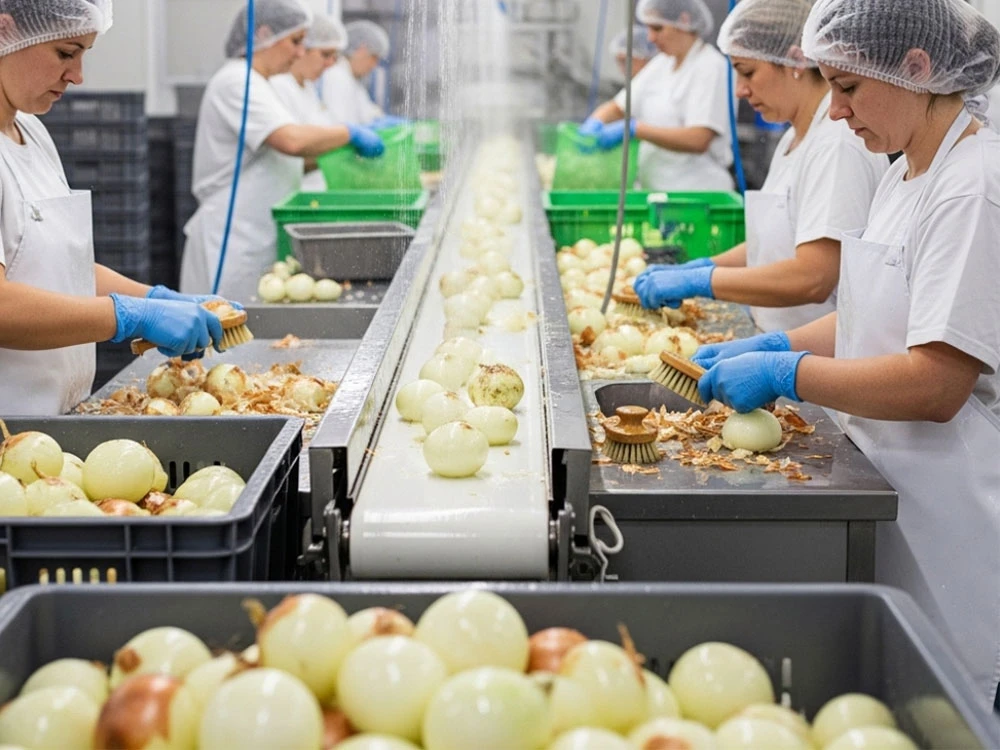

The picture shows our onion food factory processing customer with a daily processing capacity of 20 tons. After using our FL-SAEW-1T equipment, microbial control and no residue on the surface have been achieved. Meeting export standards and increasing the enterprise’s benefits by 30%.
FAQ
1,How do food factory customers select hypochlorous acid generators?
Based on the daily consumption and concentration of hypochlorous acid water. The hypochlorous acid generator can operate 24 hours a day, so choosing the appropriate model can avoid waste
2. What concentration of hypochlorous acid generator do food factories generally choose?
According to the FDA standards, around 60ppm is sufficient for food contact surfaces, and around 200ppm is sufficient for food equipment disinfection. Therefore, it is recommend to use equipment with adjustable PPM ranging from 50 to 200.
3. Does the hypochlorous acid generator equipment need regular maintenance?
Our company’s hypochlorous acid generator is intelligently controll and automatically cleans the electrolytic cell, so the equipment has a high degree of intelligence and does not require regular maintenance. There are corresponding alarm information, and faults can be eliminate according to the manual or we can be connect via video for timely resolution.