

Sodium hypochlorite generators play a vital role in modern water treatment. These systems produce reliable disinfectant directly on-site. However, operators must follow specific operational rules to keep a sodium hypochlorite generator running efficiently. Two key practices stand out: avoiding industrial salt and using storage tanks instead of direct dosing.
Why Avoid Industrial Salt in a Sodium Hypochlorite Generator?
A sodium hypochlorite generator relies on high-quality salt to create a sodium hypochlorite solution through electrolysis. Using industrial salt in a sodium hypochlorite generator causes severe operational issues.
First, industrial salt contains high levels of impurities and dust. When these impurities enter the sodium hypochlorite generator, they quickly form scale on the internal components. Furthermore, heavy sludge builds up around the electrode plates. This sludge physically clogs the electrode gap. As a result, the electrolysis efficiency of the sodium hypochlorite generator drops significantly.
Second, frequent scaling forces operators to perform acid washing. Acid washing removes scale, but it gradually degrades the protective coating on the electrode plates. Over time, frequent acid washing drastically shortens the lifespan of the sodium hypochlorite generator electrodes.
Finally, impurities in industrial salt react during electrolysis. This reaction produces harmful chemical byproducts. Consequently, these byproducts compromise overall water quality, making the treated water fail safety standards. Therefore, operators should always feed high-purity salt into any sodium hypochlorite generator.
Why Avoid Direct Dosing into Water Mains or Clear Water Wells?
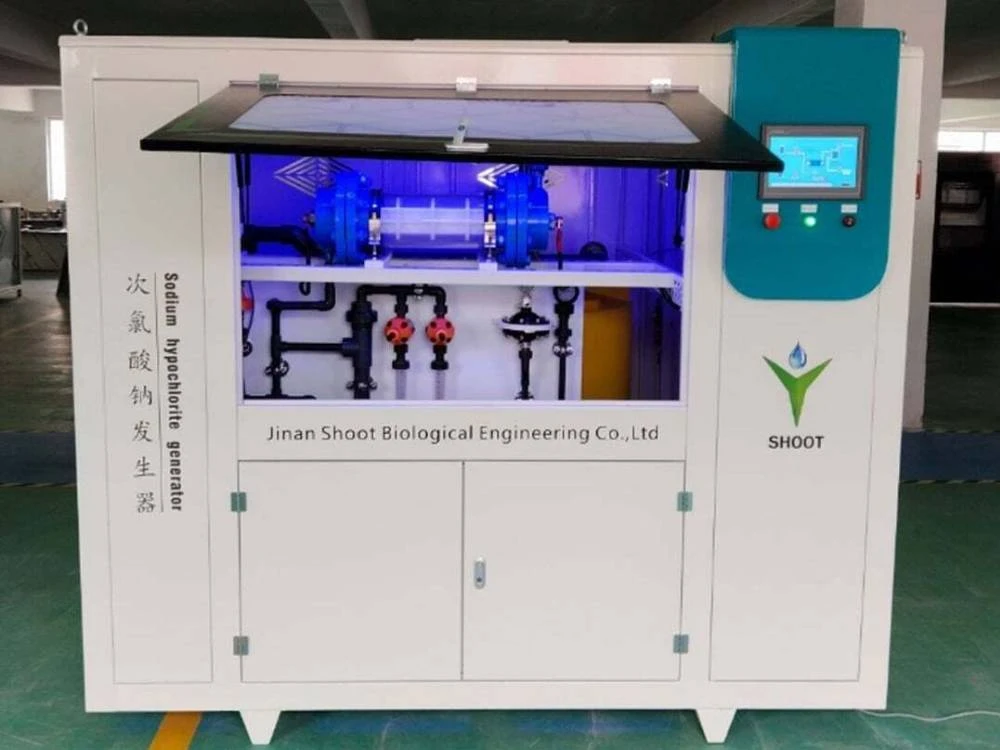
Operators should never feed sodium hypochlorite directly from the generator into water pipelines or clear water wells. Instead, a complete sodium hypochlorite generator setup requires a dedicated storage tank as a flow-stabilizing device.
To ensure continuous disinfection, the production rate of a sodium hypochlorite generator must exceed the dosing rate. Direct dosing creates immediate risk. If the generator slows down or stops, the residual chlorine in the output water drops below required safety levels.
A dedicated storage tank solves this problem through a simple automated cycle:
Startup and Filling: When the sodium hypochlorite generator starts, its production rate exceeds the dosing demand. As a result, the sodium hypochlorite liquid level in the storage tank rises steadily.
Automated Shutdown: The sodium hypochlorite generator continues running until the liquid level reaches the set maximum limit. At this point, the generator automatically turns off to prevent overflow.
Continuous Dosing: Dosing continues seamlessly using the stored sodium hypochlorite solution. Consequently, the liquid level in the tank gradually drops.
Automated Restart: Once the liquid reaches the set minimum level, the sodium hypochlorite generator turns back on automatically.
This smart storage buffer guarantees a constant, steady supply of sodium hypochlorite. Thus, the water plant maintains optimal chlorine levels without interruption.
Summary
In summary, proper management ensures long-term performance for any sodium hypochlorite generator. Using pure salt prevents electrode clogging, extends equipment lifespan, and stops harmful byproducts. Meanwhile, integrating a storage tank maintains stable sodium hypochlorite dosing and protects water quality. By adhering to these two principles, facilities can maximize the efficiency and reliability of their sodium hypochlorite generator systems.
Contact us:
Tel/whatsapp: +86 185 6003 3956
E-mail: [email protected]
Website: https://hoclgenerator.com
FAQ
Why is standard industrial salt not recommended for sodium hypochlorite generators?
Industrial salt contains high levels of raw minerals, heavy metals, calcium, magnesium, and insoluble dust. These impurities cause heavy scale buildup inside the electrolytic cell and create sludge that clogs electrode flow channels. This clogging severely reduces chlorine generation efficiency, increases power consumption, and shortens the lifespan of ruthenium-iridium titanium electrode coatings due to frequent acid washing.