

In daily life, many people think that the higher the concentration of disinfectant, the better the bactericidal effect. For hypochlorous acid, a common disinfectant, this intuition is not entirely true. In fact, there is no simple proportional relationship between the bactericidal efficiency and the concentration of hypochlorous acid. Which involves complex chemical mechanisms and practical application limitations.
Principle of hypochlorous acid sterilization
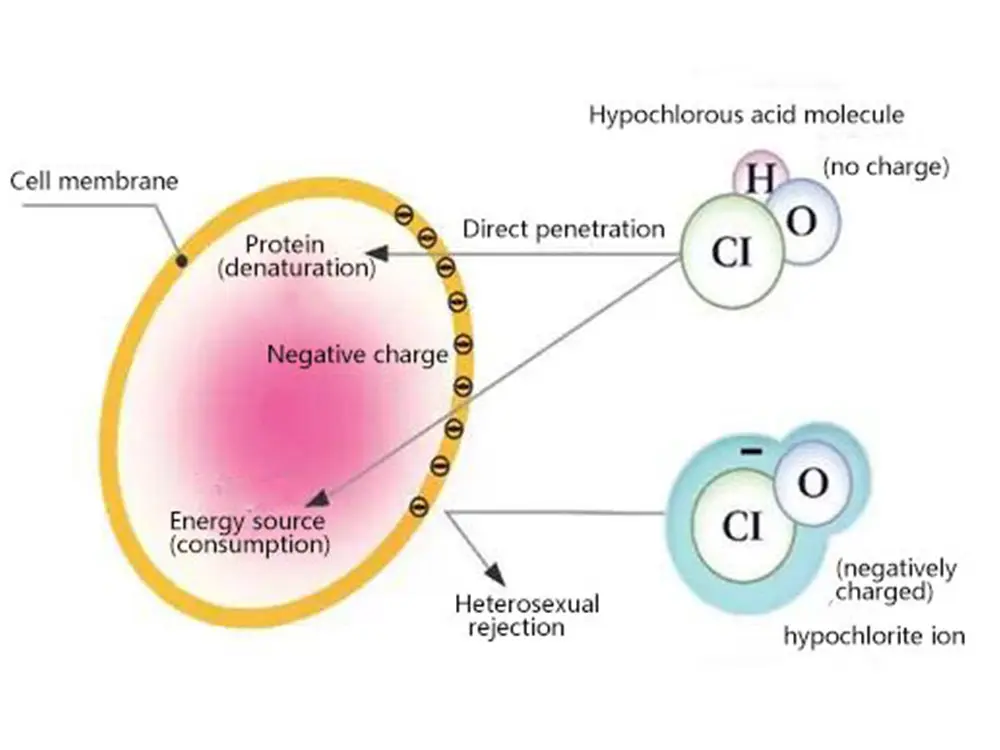
The reason why hypochlorous acid can effectively kill bacteria. Mainly depends on its strong oxidation. Hypochlorous acid molecules can penetrate the bacterial cell wall and have oxidation reactions with biological macromolecules such as proteins and nucleic acids in the cells. Making the pathogen inactive. It is worth noting that it is hypochlorous acid molecules (HOCl) rather than hypochlorite ions (ClO⁻) that actually act as bactericidal agents. Under different pH and concentration conditions, the ratio of HOCl and ClO⁻ in the solution changes significantly, which directly affects the bactericidal effect.
The effect of increased concentration on hypochlorous acid
At lower concentrations, appropriately increasing the concentration of hypochlorous acid does indeed enhance the disinfection effect. Higher concentrations mean there are more effective HOCl molecules in a given volume. Increasing the chances of contact with pathogens and enabling the disinfection process to be completed more quickly.
However, this positive relationship has an obvious “plateau zone”. Once the concentration exceeds a certain critical value. Further increasing the concentration brings very limited improvement in the sterilization efficiency. Many studies have shown that a 50-200 ppm hypochlorous acid solution can achieve a sterilization rate of over 99.99% for the vast majority of common pathogens. Increasing the concentration to hundreds or even thousands of ppm may only shorten the sterilization time from 30 seconds to 15 seconds. The significance of such an improvement in practical applications is limited.

Side effects and risks of high concentrations
The problems caused by high concentrations of hypochlorous acid cannot be ignored:
- Enhanced corrosion on the surface: high concentration of hypochlorous acid has a stronger corrosion effect on metals, rubber, plastics and other materials, which may damage the disinfected items.
- Increased irritant odor: the higher the concentration, the heavier the odor of the released chlorine gas, which irritates the respiratory and eyes of the operator, and is particularly dangerous in confined Spaces.
- Residual problem: If washing is not thorough after high concentration disinfection, residual hypochlorous acid may have adverse effects on human health or subsequent process.
- Increased instability: hypochlorous acid itself is unstable, the decomposition speed of high concentration solution is faster, and the storage validity period is shorter, but it causes waste.
Optimal concentration selection in practical use
Considering the bactericidal effect and safety, the optimal concentration of hypochlorous acid is usually between 50 and 200ppm. The specific selection should consider the following factors:
- Application scenarios: the surface of food processing equipment can use a lower concentration of 50ppm. Highly contaminated areas in medical environments may require 200ppm.
- Pathogen type: common bacterial propagule 50ppm can effectively kill. Spores and some viruses may require higher concentrations or longer periods of action.
- Contact time: if only a short time of contact can be provided (such as spray disinfection). The concentration can be appropriately increase. If allowed to soak for a few minutes, the lower concentration is perfectly sufficient.
- Organic matter interference: In the presence of organic matter such as blood and secretions. The effect will decrease under the same concentration. And it may be necessary to increase the concentration or clean first.

The concentration and bactericidal effect of hypochlorous acid is not simply “the higher the better”. After the effective concentration threshold is reached. The marginal benefit of further increasing the concentration is very small. But it may bring negative effects on corrosion. Safety and economy. Scientific disinfection practice should pursue the optimal concentration of “sufficient and safe”. Rather than blindly pursuing high concentration. For most daily disinfection needs, use in strict accordance with the dilution ratio recommended by the product instructions, with appropriate contact time and surface cleaning, you can obtain the ideal sterilization effect. Moderation, not extremes, is the wisdom of effective sanitization.
FAQ
Hypochlorous acid generator can be used for sterilization of which scenes?
The application scenarios of hypochlorous acid generator are diverse, such as medical field, agricultural cultivation, animal husbandry, food processing and other fields will be involve in hypochlorous acid generator